AI and A/B Testing: Optimizing E-commerce Campaigns
AI accelerates and automates A/B testing for e-commerce: massive variants, real-time adjustments, and improved ROAS.
Traditional A/B testing is often lengthy, limited in variations, and poorly suited to the current complexity of e-commerce. Artificial intelligence (AI) completely changes the game by automating the creation, analysis, and adjustment of advertising campaigns. With tools like Feedcast.ai, you can:
- Test up to 150 variants simultaneously in just a few minutes.
- Adjust your campaigns in real-time based on user behavior.
- Centralize the management of your campaigns across Google, Meta, and Microsoft Ads.
- Reduce your advertising costs, with an example being an 18% decrease in CPC.
The results are clear: an average increase of 23% in ROAS and an overall performance improvement of 64%. AI saves time, optimizes your budgets, and delivers more accurate results while simplifying multi-channel management. With solutions starting at €99/month, integrating AI into your advertising campaigns becomes an essential asset to remain competitive.
How the AI on E-commerce Stores Actually Works
Problems with Traditional A/B Testing in E-commerce
Traditional A/B testing presents several challenges that limit the effectiveness of e-commerce campaigns. Designed for an era when each variant required significant design and development efforts, these methods no longer meet the current market demands. Here are the main obstacles.
Slow Setup and Extended Timelines
Setting up a traditional A/B test is a time-consuming task. Each adjustment often requires tickets for the development team or complex integrations into CMS, significantly slowing down responsiveness to market trends [4]. Once the test is launched, it can take several weeks to obtain statistically reliable results [1]. During this time, market conditions and consumer behaviors may evolve, making the conclusions less relevant.
Reduced Sample Size and Limited Accuracy
Traditional A/B tests generally divide the audience into small groups. Teams often limit themselves to two or three variants, as producing more versions requires too many resources [1]. This narrow approach prevents leveraging personalization opportunities and favors seeking an average experience rather than addressing the diverse needs of consumers [1]. In an e-commerce context where audiences are often highly fragmented, these small samples hinder obtaining reliable data and reduce the impact of optimizations.
Difficulty Testing Across Multiple Platforms
Conducting consistent tests across platforms like Google, Meta, or Microsoft Ads is a major technical challenge. Each channel imposes its own requirements in terms of formats, titles, or visuals, forcing marketing teams to manually adapt each element [4][6]. Moreover, performances are often siloed in separate dashboards, preventing a comprehensive view of results [3]. Manual updates of product catalogs further complicate matters, creating discrepancies that can lead to inconsistencies in pricing or stock across different channels [3][4]. In 2024, Claudie Pierlot managed to increase its conversion rate by 36% on Meta Shopping Ads by adopting automated and continuous A/B testing [4].
How AI Improves A/B Testing for E-commerce
Artificial intelligence is profoundly transforming how A/B tests are conducted in the e-commerce sector. Where traditional methods required weeks of work and tedious manual management, AI accelerates processes and opens the door to more advanced optimizations. Let's take a closer look at how it intervenes in creation, analysis, and real-time adjustment.
Automated Creation and Testing of Ad Variants
Thanks to AI, it is now possible to automatically generate a large number of ad variants. For example, language models like GPT-3 can produce titles, descriptions, and calls to action tailored to each platform, while AI-assisted image editing tools transform simple photos into professional-quality visuals [5]. Unlike traditional tests, which are limited to a few options, AI allows for simultaneous testing of dozens, even hundreds, of combinations. Analysis tools reach a confidence level of 95% in determining the best variants, such as a simple title change that can lead to an 18% increase in conversions [5].
Solutions like Feedcast.ai further automate this process by synchronizing each variant across platforms like Google, Meta, and Microsoft Ads, eliminating manual updates. This also ensures real-time consistency in pricing and stock [3]. This type of automation accelerates results and facilitates predictive analysis.
Predictive Analysis for Accelerated Results
Predictive analysis allows for anticipating results without waiting for the complete end of a campaign. By using smaller samples, predictive models quickly identify the best-performing variants [9]. AI is also capable of detecting subtle trends that are invisible to the human eye by analyzing vast datasets. This information often reveals unexpected business opportunities [7].
This type of approach is particularly advantageous for growing businesses. Some report revenue increases ranging from 10% to 15%, and in some cases, up to 25%, thanks to AI-driven personalization [8]. But AI is not just about prediction: it also excels in continuously adjusting campaigns.
Real-Time Adjustments Based on User Behavior
One of the great strengths of AI lies in its ability to instantly adjust campaigns based on user reactions. Automated features, such as "Autopilot" mode, continuously manage bids, targeting, and budget allocation, maximizing return on ad spend (ROAS) [3]. Unlike traditional A/B tests that require manual intervention after each cycle, AI works continuously to optimize performance.
Consumers increasingly expect personalized interactions, and AI meets this demand by dynamically adapting ad variants to each visitor based on their profile and behavior [8]. Additionally, companies collaborating with Google-certified CSS partners via AI platforms benefit from an automatic 20% reduction in CPC bids for Google Shopping [3]. These AI-driven adjustments can improve advertising performance by up to 64% compared to traditional campaigns [3].
Case Study: AI-Driven A/B Testing by Feedcast.ai for Multi-Channel Campaigns
Traditional A/B testing quickly shows its limits in the face of the complexity of modern advertising campaigns. This is where Feedcast.ai comes in, a platform adopted by over 3,000 brands [3], which automates and centralizes ad management across Google, Meta, and Microsoft Ads. The results speak for themselves: a 64% increase in performance compared to traditional campaigns, an average ROAS increase of 23%, and an 18% improvement in CPC efficiency [3].
AI-Optimized Product Feed Management
With its AI Studio, Feedcast.ai transforms basic images into professional visuals in no time. AI removes backgrounds, enhances visual quality, and generates countless variants to test the style that generates the most conversions [3]. Simultaneously, it updates product data in real-time to ensure perfect consistency across all advertising channels. This avoids unnecessary spending on out-of-stock products [3]. This fully automated process paves the way for centralized campaign management via a single dashboard.
A Centralized View for Multi-Platform Campaigns
Once product feeds are optimized, Feedcast.ai consolidates all essential data into a single dashboard. You can find key indicators such as ROAS, CPC, and budget allocation. For example, you can see at a glance that 54% of the budget is allocated to Google, 27% to Facebook, and 19% to Microsoft Ads. This information allows for quick adjustments to your strategy based on observed performance [3].
Automated Creation of Ad Variants and Intelligent Segmentation
Feedcast.ai automatically generates multiple versions of ad texts tailored to each platform while segmenting audiences through its Smart Labels [3]. The Autopilot mode then takes over to adjust bids, targeting, and budget in real-time, maximizing ROAS [3]. As a Google-certified CSS partner, the platform also offers an automatic 20% reduction in CPC bids for Google Shopping. For example, a standard CPC of €0.85 can be reduced to €0.68 [3]. This approach accelerates the detection of high-performing variants, far surpassing traditional A/B testing methods.
How to Set Up AI-Driven A/B Testing with Feedcast.ai
Connecting Advertising Accounts and Importing Product Feeds
Start by connecting your Google, Meta, and Microsoft advertising accounts to Feedcast via a single interface. By centralizing your campaigns on one platform, you simplify their management. Next, import your product catalog directly from your preferred e-commerce platform (Shopify, WooCommerce, or Prestashop) or using Google Sheets, CSV, or XML files [3]. Once imported, your products automatically sync across channels like Google Shopping and Meta Catalog [3].
Feedcast also offers AI Studio, a tool that enhances your visuals by removing backgrounds, increasing their quality, and generating multiple variants. This helps you identify the most effective visual styles for your audiences [3]. Thanks to this automated optimization, your product feeds are ready to perform even before launching your campaigns.
Launching AI-Optimized Multi-Channel Campaigns
With your enriched feeds, Feedcast automatically generates tailored versions of your ad texts for each platform. Smart Labels intelligently segment your audiences and adjust bids, targeting, and budget allocation in real-time [3]. The Autopilot mode then takes over to continuously maximize your ROAS [3].
This approach allows you to test a larger number of ad variants without increasing your spending while optimizing your campaigns across multiple channels.
Using Analytics to Improve Performance
Once your campaigns are launched, Feedcast provides real-time analysis of their performance. The unified dashboard displays key metrics such as ROAS, CPC, and total spend for Google, Meta, and Bing [3]. This allows you to monitor budget allocation and quickly identify the most profitable channels [3].
Meanwhile, Smart Labels alert you as soon as AI has sufficient data to adjust bids and refine targeting [3]. Additionally, the tool ensures that any price or stock updates are synchronized across all platforms within minutes [3]. This responsiveness allows you to adapt your strategy in real-time, without waiting weeks to see results.
Measurable Results from AI-Driven A/B Testing
::: @figure 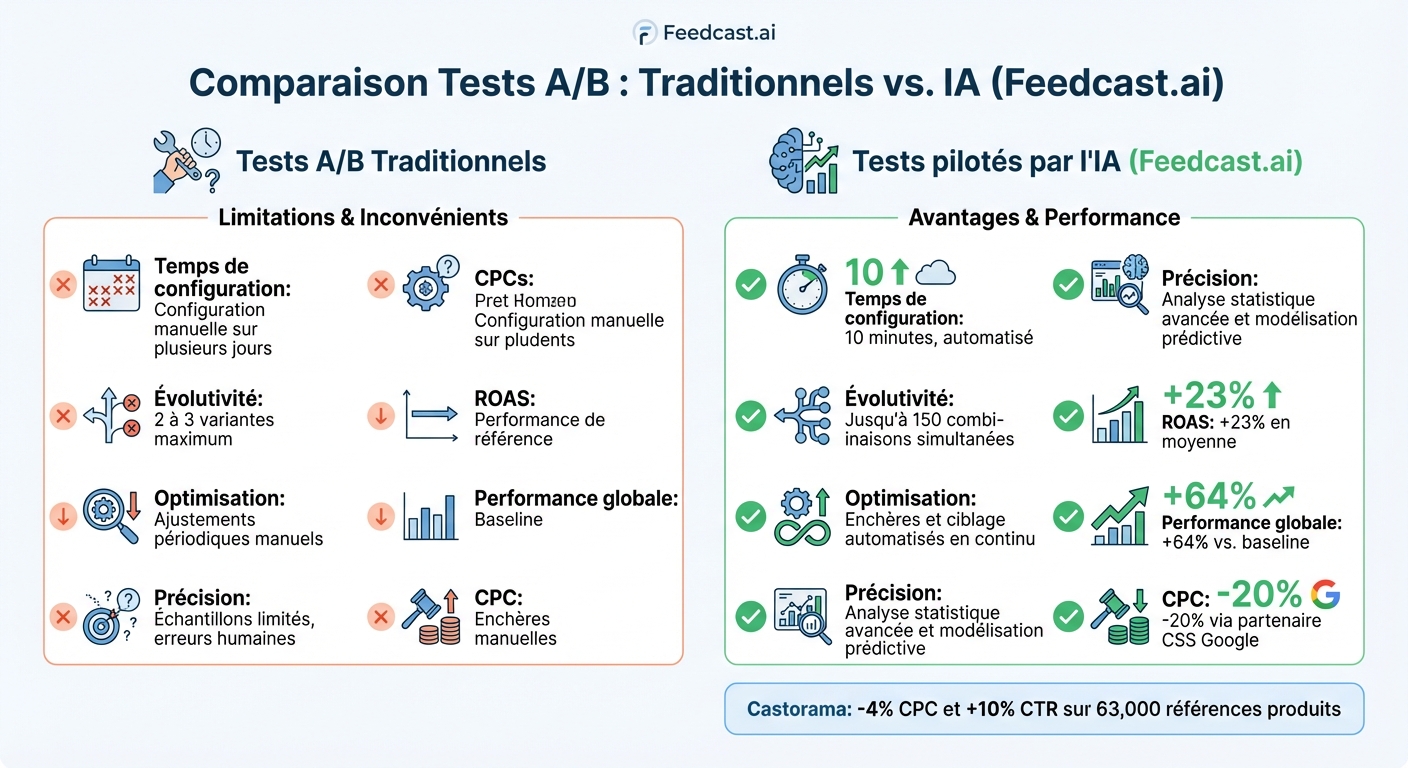 {Traditional A/B Testing vs AI-Driven A/B Testing: Performance Comparison}
Data clearly shows that integrating AI through Feedcast.ai can transform the management and effectiveness of multi-channel campaigns.
Comparison Table: Traditional Testing vs. AI-Driven Testing
Traditional methods require several days to set up a few variants, while AI can test up to 150 combinations in just 10 minutes [5][2].
| Criteria | Traditional A/B Testing | AI-Driven Testing (Feedcast.ai) |
|---|---|---|
| Setup Time | Manual setup over several days | 10 minutes, automated [5] |
| Scalability | Maximum of 2 to 3 variants | Up to 150 simultaneous combinations [2] |
| Optimization | Periodic manual adjustments | Continuous automated bids and targeting [3] |
| Accuracy | Limited samples, human errors | Advanced statistical analysis and predictive modeling [5] |
| ROAS | Benchmark performance | +23% on average [3] |
| Overall Performance | Baseline | +64% vs. baseline [3] |
| CPC | Manual bidding | -20% via Google CSS partner [3] |
A notable example: Castorama used AI to rewrite the titles of 63,000 product references. The result? A 4% reduction in CPC and a 10% increase in CTR [6].
These figures unequivocally demonstrate the impact of automation on ROI and time, as detailed below.
Better ROI and Time Savings
These improvements are not just abstract data: they translate into superior return on investment and significant time savings. Thanks to continuous optimization of bids and targeting by Feedcast.ai, campaigns achieve an average ROAS improvement of 23% and an 18% reduction in CPC [3]. These adjustments, impossible to achieve manually, ensure optimal use of every euro spent.
The time savings are also impressive. 46% of users report that generative AI boosts their productivity by over 40% [2]. By adjusting your campaigns in real-time, AI allows you to focus on strategic tasks. Meanwhile, AI-optimized organic listings can generate up to 340% more traffic without additional cost per click [3].
Conclusion
Artificial intelligence has profoundly changed how e-commerce merchants approach A/B testing and advertising optimization. Where traditional methods required days of preparation to test a few variants, AI can analyze up to 150 combinations simultaneously [2]. And it's not just about speed: it continuously adjusts campaigns, 24/7, with a precision that exceeds human capabilities [3].
The results speak for themselves. Companies that integrate solutions like Feedcast.ai see an average increase of 23% in their ROAS and an 18% decrease in their CPC [3]. As Romain Rissoan, a digital transition expert, emphasizes:
“AI has become an essential tool for optimizing advertising campaigns. By combining creativity, precise targeting, and rigorous data management, it offers businesses unprecedented opportunities” [2].
But the benefits do not stop at improving advertising performance. AI also saves valuable time. Nearly 46% of users claim that generative AI increases their productivity by over 40% [2]. This freed-up time allows marketing teams to focus more on strategy and less on repetitive tasks. With a centralized dashboard and its status as a Google CSS partner, Feedcast.ai offers a solution perfectly tailored to the needs of e-commerce merchants [3].
Whether you manage a burgeoning online store or an established brand, integrating AI is no longer an option but a necessity to remain competitive. With a free offer to get started and plans starting at €99/month, Feedcast.ai makes this technology accessible without requiring a significant initial investment [3].
FAQs
How can AI improve the efficiency of A/B testing in e-commerce campaigns?
Artificial intelligence changes the game for A/B testing by enhancing their accuracy while speeding up the process. Unlike traditional approaches, AI allows for real-time adaptation of experiences to each user, resulting in more relevant outcomes while minimizing biases.
With advanced statistical models, AI can simultaneously analyze multiple variables, quickly identifying the most effective variant, even with modest data samples. At the same time, it automates and continuously adjusts tests, ensuring reliable results and data-driven informed decisions.
In the e-commerce sector, tools like Feedcast leverage these technologies to enrich product listings, automatically create ad variants, and optimize advertising campaigns. The result? A notable improvement in return on ad spend (ROAS).
What benefits does Feedcast.ai bring to optimize multi-channel advertising campaigns?
Feedcast.ai makes managing advertising campaigns much easier by consolidating all your actions on a single platform. You can connect your Google, Meta (Facebook and Instagram), Microsoft accounts, and soon TikTok, to manage, track, and optimize your ads from a unified dashboard. The integration of AI automatically enriches your product listings by improving titles, descriptions, and attributes, boosting their visibility and,
Yohann B.