How IA boosts customer acquisition with dynamic ads
How AI personalizes and optimizes dynamic ads to increase clicks, reduce acquisition costs, and centralize multichannel management.
Acquiring customers online is expensive, especially when advertising campaigns lack precision. Traditional methods, based on static ads and manual targeting, often waste budgets without delivering the expected results. Conversion rates are stagnating: 9 % on Facebook Ads, 4 % on Google Ads.
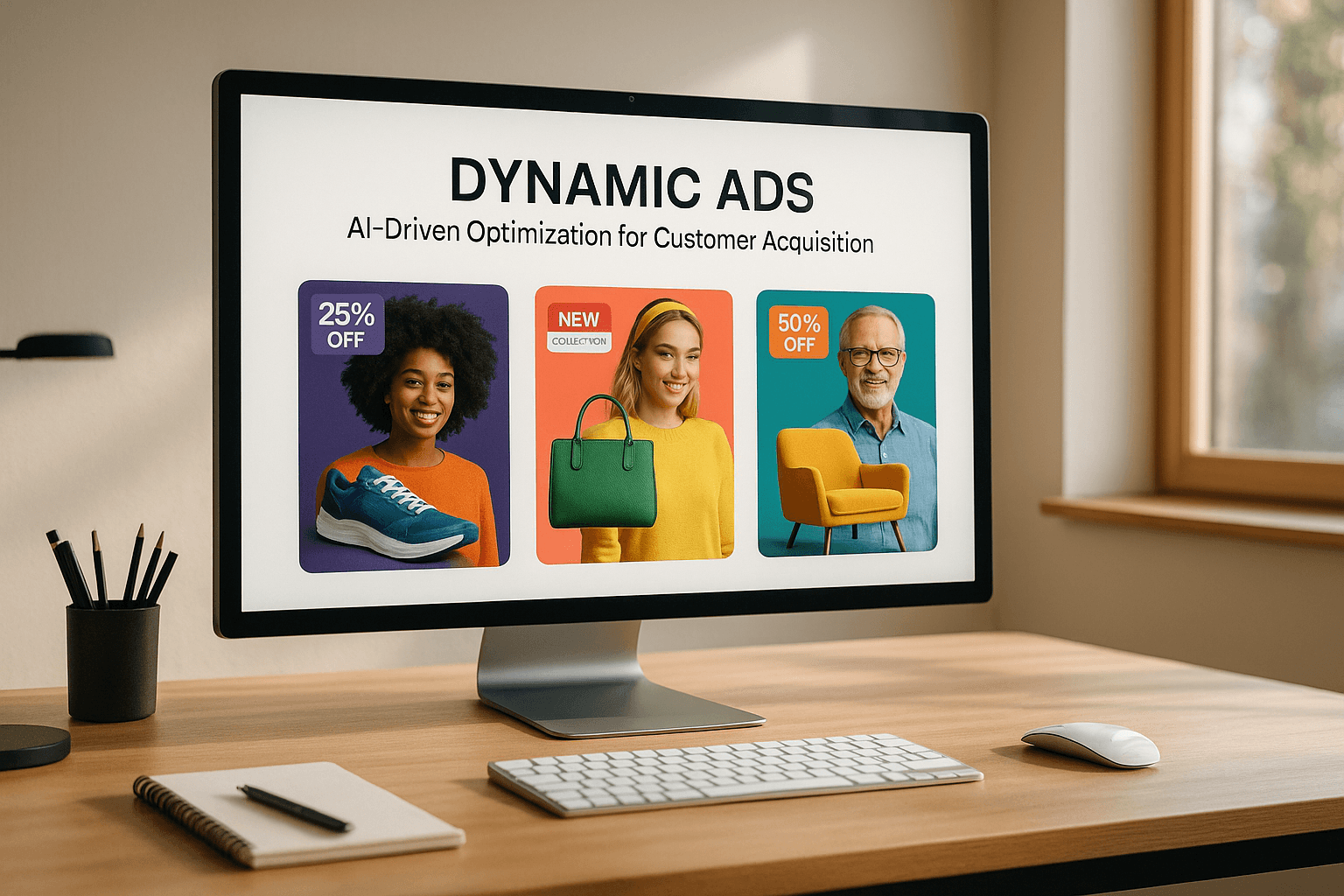
Artificial intelligence (AI) is changing the game by analyzing user behavior in real time to deliver personalized ads. Results?
- +34 % click-through rates
- -38 % cost per acquisition
- Up to 90 % reduction in cost per purchase
By automating targeting, bidding, and campaign management across multiple platforms, AI simplifies operations while maximizing performance. Tools like Feedcast centralize these processes, enabling precise tracking and continuous optimization, even with modest budgets.
Points clés :
- Problems with traditional methods : broad targeting, generic ads, complex management.
- Benefits of AI : personalized ads, automatic optimization, centralized management.
- Measurable impact : improved ROI, time saved, more effective campaigns.
AI is no longer a luxury, but an essential lever to boost your e-commerce advertising campaigns.
Maîtrisez la Création de Publicités avec IA : De Canva à Facebook Ads [ Part 3 ]
Common problems in e-commerce customer acquisition
Now that we've identified the limits of traditional methods, let's dive into the specific challenges e-merchants face.
Manual targeting wastes ad budget
Manual targeting is often the cause of wasted resources. By targeting audiences unlikely to buy, advertisers squander their budget on prospects who have little interest in their products. Without real-time analysis of user behavior, ads end up reaching poorly targeted people. Result: skyrocketing customer acquisition costs (CAC) and disappointing click-through rates.
Data confirms this: average conversion rates remain low, highlighting how ineffective traditional campaigns are. Conversely, companies that adopt AI-driven strategies see noticeable changes. For example, dynamic ads optimized by AI can generate a 34 % increase in click-through rates and a 38 % reduction in cost per acquisition[2].
The real problem with manual targeting is that it cannot detect high-intent buyers. Companies continue to spend on audience segments with little promise, instead of focusing their efforts on prospects who are genuinely interested. This lack of precision ultimately weighs heavily on campaign profitability.
But targeting isn't the only issue: static ads also pose a serious obstacle.
Static ads fail to engage users
Static ads take a one-size-fits-all approach, delivering the same message to everyone without considering users' preferences or purchasing behavior. Imagine a web user who recently searched for running shoes receiving the same ad as someone interested in winter coats. This lack of relevance leads users to ignore these ads or even block them.
Personalization changes the game. Dynamic ads, which adapt to users' specific needs, far outperform static ads in terms of engagement and cost per acquisition. In contrast, traditional approaches are defined by their inability to personalize content.
Another problem with static ads is ad fatigue. Users, exposed to the same repetitive content, end up ignoring these messages. Unable to adjust in real time, these ads cannot adapt their content based on user reactions.
According to a study, 78 % of consumers are more likely to repurchase when they receive personalized content[6]. This highlights the gap between today's shoppers' expectations and what static ads can offer. Companies that continue to use generic messages and unappealing visuals miss out on huge conversion opportunities.
But that's not all: managing campaigns across multiple platforms adds an additional layer of complexity.
Managing multiple platforms creates complexity
Running campaigns on Google, Facebook or Instagram without centralized tools greatly complicates operations. Each platform requires distinct configurations, separate product feeds and independent dashboards, which fragments the whole process.
This dispersion leads to several problems. For example, product data can become inconsistent from one platform to another, which confuses users and reduces the effectiveness of advertising campaigns.
Performance tracking also becomes a headache. Teams have to juggle between different interfaces to identify which channel delivers the best return on investment. This disconnected approach prevents leveraging global analytics that could improve results.
Every update, whether a price, a description or an image, must be manually reproduced on each platform. This not only increases the risk of errors, but also consumes valuable time.
In the end, marketing teams waste hours on administrative tasks instead of focusing on more effective strategies. For example, synchronizing audience segments between Facebook and Google Ads requires constant adjustments, because what works on one platform doesn't directly translate to another.
This complexity leads to missed opportunities. Without a unified overview, companies struggle to quickly reallocate budgets to the best-performing channels or to identify new trends before it's too late.
How AI-driven dynamic ads solve these problems
Artificial intelligence is disrupting the world of e-commerce advertising. By combining machine learning and automation, AI-driven dynamic ads overcome the limits of traditional methods while delivering concrete, measurable results.
AI targets buyers most likely to buy
Through continuous analysis of user behavior, AI identifies consumers with high purchase intent. Unlike manual targeting, often based on assumptions or rigid audience segments, AI relies on precise data such as browsing history, searches made, previous interactions with a brand and engagement habits across various platforms[2][5].
For example: if a user clicks on an ad for running shoes, AI recognizes them as a potential buyer in the sportswear category. It then automatically suggests complementary products[2]. This system continuously monitors behaviors to identify the most relevant items, allowing companies to display ads perfectly tailored to each profile[5].
AI goes further by detecting micro-segments. For example, it can spot a group of fitness enthusiasts aged 25 to 34, primarily active in the evening, and automatically generate personalized videos from existing assets to target them effectively[2]. This level of precision significantly reduces wasted spend related to poorly qualified audiences.
A retailer that adopted this automated approach reduced its cost per acquisition by nearly 90 % by reallocating its budget to AI-driven campaigns[2]. By precisely identifying potential buyers, these tools enable continuous optimization of ads.
AI improves ad creatives in real time
AI doesn’t just serve ads — it continuously tests and optimizes formats, visuals and messaging to maximize impact. By automatically adjusting thumbnails, titles and calls-to-action, it ensures constant optimization based on real-time data[2].
Brands that adapt their ads mid-campaign using AI see an increase of 18 % in return on investment compared with those using fixed creatives[2].
A concrete example: a retail brand saw a rise in clicks on carousel videos and immediately reallocated 30 % of its daily budget to that format. Result: a decrease of 12 % in cost per acquisition in just one weekend[2].
AI can also generate thousands of creative variations in minutes, enabling large-scale personalization[4]. Rather than manually creating dozens of versions tailored to different segments, AI automatically produces targeted content. For example, a user who viewed running shoes will see ads including those shoes as well as complementary items like socks or fitness accessories, increasing the chances of conversion[4].
In one campaign, AI-optimized video creatives produced a 22 % increase in engagement compared with static images[2]. In addition to content optimization, automation simplifies ad management across multiple channels.
Centralized platforms make multichannel management easier
Managing campaigns on Google, Meta and Microsoft Ads from a single interface is a real game-changer. Centralized platforms, like Feedcast, connect all ad accounts to a single dashboard. This makes it possible to track performance and adjust campaigns across channels effortlessly[2].
These tools also simplify product data management. Companies can import their catalogs from platforms like Shopify, WooCommerce or Prestashop, or via files like Google Sheets, CSV or XML. AI then enriches this data by optimizing titles, descriptions and other attributes, which improves visibility and ad performance[2].
One of the main advantages is the elimination of fragmentation. Unified analytics provide real-time metrics and detailed reports, allowing strategies to be adjusted quickly and efficiently[2].
Each price, description or image update is automatically synchronized across all platforms, avoiding manual errors and freeing up time for marketing teams. They can then focus on strategic tasks rather than repetitive operations.
For example, Feedcast offers intelligent targeting combined with automatic bidding and 24/7 budget optimization. This allowed increasing advertising ROI by 64 % in automatic mode[1]. The platform shows an average ROAS of 4,2x, proving the effectiveness of this centralized approach[1].
On top of all this, these systems enable near-instant budget reallocation. Rather than waiting several days to shift funds between channels, AI redistributes budgets within minutes based on real-time performance[2]. This flexibility ensures that every euro invested is used optimally.
sbb-itb-0bd1697
Résultats concrets des publicités dynamiques pilotées par l'IA
Les campagnes publicitaires propulsées par l'IA montrent des résultats impressionnants : un meilleur retour sur investissement, des conversions accrues et un gain de temps précieux pour les équipes marketing.
Meilleur retour sur investissement publicitaire (ROAS)
Avec l'IA, les budgets publicitaires sont automatiquement orientés vers les audiences les plus susceptibles de convertir. Résultat : moins de gaspillage et davantage de revenus pour chaque euro dépensé. Par exemple, les campagnes pilotées par l'IA affichent un taux de clics doublé et une réduction de 50 % du coût d'acquisition par rapport aux annonces statiques[3].
Selon l'étude Next in Personalization de McKinsey, une personnalisation avancée peut entraîner une hausse des revenus de 10 à 15 %[2]. Grâce à un système qui ajuste en temps réel les enchères et les budgets, chaque euro investi est optimisé pour un impact maximal.
Des plateformes comme Feedcast illustrent bien cette efficacité. En combinant ciblage intelligent, enchères automatiques et optimisation continue, Feedcast atteint un ROAS moyen de 4,2x. Les utilisateurs peuvent même constater des gains allant jusqu'à 64 % en mode automatique et 23 % supplémentaires grâce au ciblage IA[1].
De plus, en tant que partenaire CSS Google certifié, Feedcast permet une réduction de 20 % sur les enchères CPC Google Shopping. Par exemple, un CPC de 0,85 € passe à 0,68 €, augmentant ainsi le trafic sans dépasser le budget initial[1].
Ces résultats financiers s'accompagnent d'une amélioration notable des conversions et de l'engagement client.
Plus de conversions et d'engagement client
La personnalisation en temps réel est un véritable atout pour les performances publicitaires. En adaptant les annonces aux préférences individuelles, l'IA génère davantage de clics, un engagement prolongé et des taux d'achat plus élevés.
L'IA analyse en continu les comportements des utilisateurs, comme l'historique de navigation ou les recherches, pour proposer des messages et produits qui leur correspondent parfaitement[2][4]. Ce niveau de précision crée une expérience fluide et pertinente, propice à la conversion.
Les marques qui ajustent leurs publicités en cours de campagne grâce à l'IA enregistrent jusqu'à 18 % de ROI supplémentaire par rapport à celles utilisant des créations fixes[2]. Un exemple frappant : une marque retail a constaté une hausse de 22 % de l'engagement sur les vidéos par rapport aux images statiques, seulement quelques heures après le lancement d'une campagne IA[2].
L'IA ne se limite pas à proposer des produits. Elle recommande également des articles complémentaires. Par exemple, un utilisateur intéressé par des chaussures de running pourrait voir des chaussettes de sport ou des accessoires de fitness, augmentant ainsi la valeur moyenne du panier[4].
Le retargeting intelligent est un autre levier puissant. L'IA cible les utilisateurs ayant montré un intérêt sans finaliser leur achat, avec des publicités personnalisées pour les réengager[5]. Ces audiences, déjà sensibilisées, affichent souvent des taux de conversion plus élevés que les prospects froids.
Enfin, les modèles de tarification dynamique améliorent encore les performances. L'IA ajuste les prix en temps réel en fonction des comportements clients, de la demande et de la concurrence, proposant des remises personnalisées au moment opportun pour séduire les acheteurs sensibles aux prix[5].
Less manual work, more time for strategy
In addition to improving results, automation significantly reduces the workload of marketing teams. Repetitive tasks like bid adjustments, creative testing, or budget reallocation are fully automated, freeing up time to focus on strategic initiatives.
AI-driven platforms can generate thousands of creative variations in a few minutes. This allows brands to personalize campaigns at scale without manual effort[4]. For example, AI automatically identifies the most engaging content for each target segment.
Real-time updates also eliminate human errors. A price or image change is instantly applied across all advertising platforms. Feedcast, for example, automatically synchronizes product data across all channels, ensuring perfect consistency without manual intervention[1].
Unified dashboards simplify data analysis. By bringing Google, Meta, and Microsoft metrics together in a single interface, marketers save valuable time and can make informed decisions more quickly[1].
Finally, continuous optimization runs 24/7. While teams focus on overall strategy, AI adjusts bids and reallocates budgets to the best-performing campaigns. Retailers using dynamic product feeds and structured creative rules often see significant decreases in CPA, especially during peak periods[2].
With accessible investments, starting at 99 € HT per month, businesses can benefit from these advances while saving time and achieving optimal results[1].
Conclusion
AI-powered dynamic ads are profoundly changing how e-commerce businesses attract and convert customers. This technology addresses three major problems: often inefficient manual targeting, the lack of appeal of static ads, and the complexity of managing campaigns across multiple platforms.
Thanks to AI-driven optimization, advertisers see notable improvements. Click-through rates increase while acquisition cost decreases significantly. For example, some retailers have observed up to a 90% reduction in their acquisition cost after reallocating a large portion of their budget to automated campaigns[2].
By automating processes, AI frees marketing teams from repetitive and time-consuming tasks. It also enables generating ad variations tailored to different audiences in record time while continuously optimizing campaigns. This time savings allows teams to focus on higher-value strategies.
Solutions like Feedcast perfectly illustrate this revolution. These centralized platforms simplify ad management across channels such as Google, Meta, and Microsoft. They make advanced AI optimization tools accessible even to small businesses. With features like intelligent targeting and automatic product data synchronization, e-merchants benefit from simplified and efficient management[1].
One major strength of these dynamic ads is their ability to personalize messages in real time. Rather than serving generic ads, AI tailors each piece of content to user behavior, thereby increasing the chances of conversion and engagement.
For e-commerce businesses, integrating AI into their advertising strategies is no longer optional but necessary. As we have seen, these technologies reduce costs, improve performance, and simplify operations. Brands that adopt these solutions gain a clear competitive advantage: more efficient customer acquisition and measurable growth that endures over time.
FAQs
How does AI improve ad personalization for each user in real time?
Artificial intelligence is transforming how ads are designed and delivered by relying on analysis of users' online behaviors, preferences, and interactions. With tools like Feedcast.ai, it is now possible to adjust ad campaigns in real time to reach precise audiences and increase their effectiveness.
By automating product data management and creating tailored ad content, AI gives businesses a twofold opportunity: attract new customers while strengthening loyalty among existing ones. The result? More relevant ads and easily measurable performance for online stores.
What are the benefits of AI-driven dynamic ads for e-commerce businesses?
AI-powered dynamic ads, like those developed by Feedcast.ai, are radically changing how e-commerce businesses attract new customers. Thanks to AI, product data is enriched to increase item visibility across multiple advertising platforms, notably Google, Meta, and Microsoft Ads.
These automated campaigns not only simplify creation and optimization. They also allow targeting precise audiences, improving ad performance, and saving valuable time. Result: smoother management, better budget efficiency, and increased exposure of your products to consumers.
How do platforms like Feedcast make managing ads across multiple channels easier?
Centralized platforms, such as Feedcast, simplify ad management by bringing all your ad accounts into a single place. With a single dashboard, you can manage and track your campaigns across different channels, which considerably simplifies the process and saves you time.
In addition to this centralization, these tools offer advanced features like product data enrichment using artificial intelligence, automatic campaign adjustments, and in-depth analytics to optimize your ad performance.
Yohann B.