Behavioral Personalization: Impact on Abandoned Carts
Real-time behavioral personalization reduces cart abandonment, boosts conversions, and improves ROI despite technical challenges.
Every day, over 70% of online carts are abandoned, resulting in billions of euros in losses for e-commerce sites. Two main approaches can reduce this issue: behavioral personalization and demographic personalization. Here’s the breakdown:
- Behavioral Personalization: Analyzes real-time actions (clicks, mouse movements, navigation) to detect abandonment intentions and intervene immediately. Results: reduces abandonment rate to 46% and increases conversions by 45%.
- Demographic Personalization: Uses static data (age, location, user profile) to segment customers and send generic messages. Results: average recovery rate of 3-4%, but less precise.
Quick Comparison
| Criteria | Behavioral | Demographic |
|---|---|---|
| Data Used | Real-time (movements) | Static (age, gender) |
| Recovery Rate | ~7.5% (e.g., LePantalon) | ~3-4% |
| Implementation Cost | High (AI/algorithms) | Low to medium |
| Precision | Very high | Average |
Conclusion: Focusing on behavioral personalization is a priority to reduce cart abandonment. Although more complex to implement, its results justify the investment, with an ROI potentially reaching 4x or more. Demographic personalization, simpler, remains useful but less effective in meeting modern consumer expectations.
::: @figure 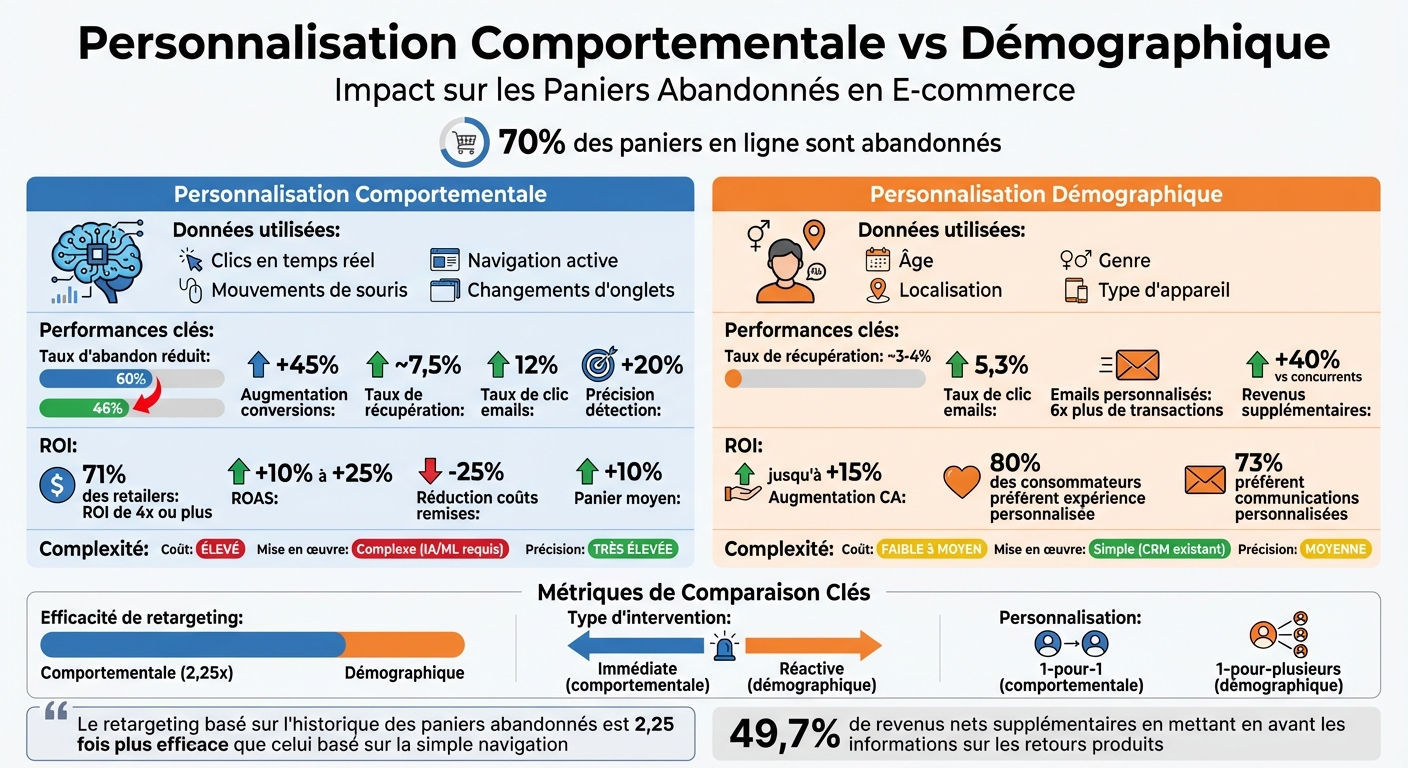 {Behavioral vs. Demographic Personalization: Performance and ROI Comparison}
3 Ideas (+1 Bonus) to Reduce Your Abandoned Carts! E-commerce
How Behavioral and Demographic Personalization Work
Behavioral personalization relies on analyzing real-time signals, such as mouse movements, scroll depth, tab changes, or session duration. This information helps detect an "exit intent" before the user leaves the site [1][5]. For instance, an AI-powered system might notice a cursor moving toward the close button and trigger a targeted action, tailored to the device specifics [1].
The algorithm can then decide if the customer needs a discount code or a reassuring message about delivery or payment security. This approach allows for reducing discount-related costs by up to 25%, avoiding offering them to visitors who don't actually need them [1]. A French brand like LePantalon adopted this strategy in June 2025. By integrating customer loyalty data into its reminder emails, it achieved a conversion rate of 7.5%, twice the industry average [6]. This reactive method is distinctly different from demographic personalization, discussed below.
In contrast, demographic personalization relies on static data, such as age, gender, or geographical location [5][6]. It segments users into broad groups and sends generic, often scheduled emails. While easier to deploy, this approach does not account for real-time behaviors that influence purchasing decisions. For example, a 35-year-old man living in Paris will receive the same message as another with a similar profile, without considering their specific interactions on the site [1].
Results clearly show the effectiveness of behavioral personalization: in France, behavior-based automated flows achieve a click rate of 12%, compared to only 5.3% for standard marketing emails [6]. A brand like Cabaïa is a good example. It automatically excludes customers with an open support ticket from promotional campaigns, thus avoiding further irritation [6]. By considering the behavioral context, this approach turns cart recovery into a proactive and relevant intervention.
| Criteria | Behavioral Personalization | Demographic Personalization |
|---|---|---|
| Data Used | Clicks, mouse movements, real-time navigation [1][5] | Age, gender, location, device type [5] |
| Depth of Personalization | Individual and contextual (1-to-1) [2] | By segment (1-to-many) |
| Average Recovery Rate | ~7.5% (e.g., LePantalon) [6] | ~3-4% (industry average) |
| Implementation Complexity | High (requires AI/ML) [1] | Low to medium (simple rules) |
| Type of Intervention | Immediate (exit intent overlays) [1] | Reactive (scheduled emails) |
1. Behavioral Personalization
Mechanisms
Behavioral personalization relies on analyzing real-time micro-behaviors. Artificial intelligence monitors subtle cues like mouse movements (especially towards the close button), tab changes, hesitations on payment pages, or scroll depth [1]. Unlike traditional static rules, this method adapts to each visitor's immediate context, allowing differentiation between, for example, "bargain hunters" and "users seeking reassuring information" [1].
The system makes instant decisions: offering a promo code or displaying a service message, such as live chat assistance or delivery details. This approach preserves margins by avoiding unnecessary discounts to customers who would have purchased anyway. Thanks to AI, detection precision can increase by up to 20% compared to simple mouse movement triggers [1]. Additionally, technical variations across operating systems require fine algorithmic adaptation.
These precise mechanisms translate directly into measurable gains in performance and recovery.
Impact on Recovery Rates
The results are impressive. Behavioral personalization reduces the average abandonment rate from 60% to about 46% [2], while increasing conversion rates by 45% on average [2]. Retargeting based on abandoned cart history ("lower funnel") is 2.25 times more effective than simple browsing-based retargeting ("upper funnel") in encouraging purchases [9].
A particularly effective strategy is highlighting product return information in recovery ad campaigns. This tactic generates 49.7% additional net revenue compared to standard product reminders [9]. In March 2025, L’Oréal adopted SiteCore's generative AI to automate metadata tagging on 200,000 titles across 36 brands and over 500 websites, saving 120,000 hours of manual work [3].
Implementation Complexity
Despite its advantages, behavioral personalization comes with major technical challenges. 96% of retailers face difficulties in their personalization efforts [2]. Common obstacles include a lack of IT resources (43% of retailers), alignment issues between internal teams (40%), and a lack of suitable tools (36%) [2].
Real-time data management is particularly complex. 49% of retailers do not leverage this data, and 51% do not consider cross-device or offline information [2]. Integration with existing marketing platforms requires significant technical resources and constant investment [5]. Finally, GDPR compliance requirements and consumer reluctance towards algorithmic tracking add an additional layer of complexity [5].
Despite these challenges, the results achieved by companies show that these efforts are worthwhile.
ROI
The numbers confirm the profitability of this approach. 71% of retailers report an ROI of 4x or more thanks to personalization [2]. For example, for 100,000 visitors, an algorithm capable of choosing between a discount voucher and a service message can save over €3,000 per month compared to a static strategy where everyone receives a discount [1].
AI-powered targeted campaigns also increase ROAS (return on ad spend) by 10% to 25% [3]. Moreover, 60% of retailers see an average cart size increase of 10% or more thanks to personalization [2]. These results show that this strategy not only improves performance but also generates sustainable and tangible benefits.
2. Demographic Personalization
Mechanisms
Demographic personalization relies on static data such as location (inferred from IP address), language, device type (mobile or desktop), and user profile information [8]. Once a visitor is identified or logged in, brands enrich their profile with CRM data, including elements like age, gender, loyalty status, and purchase history [8]. This information allows marketers to group users into specific segments based on their CRM profile [10].
Artificial intelligence then analyzes this data to identify demographic trends and predict which segments are most likely to respond positively to certain offers [5]. Websites and email campaigns use these analyses to dynamically display content tailored to each user's demographic profile [8].
| Segment Type | Targeting Mechanism | Example Content/Incentive |
|---|---|---|
| New Visitors | IP Address / First Session | Welcome discount code (-10%) [10] |
| VIP/Loyal Customers | CRM / Loyalty Status | Early access to sales or bonus points [10] |
| Geographic Targeting | IP Address | Localized language, currency, and delivery information [8] |
| Device-Specific | Browser/Device Tracking | Mobile-optimized CTAs and layout [8] |
These mechanisms lay the foundation for effective personalization, particularly to improve abandoned cart recovery performance.
Impact on Recovery Rates
Unlike the behavioral approach, which relies on dynamic data, demographic personalization uses only static data to adjust offers. While less precise, this method remains effective. For example, 73% of consumers prefer to interact with brands that personalize their communications [8], and 80% of them are more likely to buy from a brand offering a personalized experience [7]. Additionally, personalized emails generate transaction rates 6 times higher than generic emails [8].
One of the main advantages of this method is its ability to offer immediate relevance. For example, a brand can offer a discount code to welcome a new visitor or provide a loyalty points bonus to a returning customer, thus aligning the offer with the customer's lifecycle [10]. However, this approach focuses more on "who" the user is, unlike behavioral personalization which delves into the "why" of their actions, especially in the case of cart abandonment [7] [8].
Even if it lacks real-time precision, demographic personalization compensates with its ease of implementation and immediate effectiveness.
Implementation Complexity
Implementing demographic personalization is generally less complex than behavioral personalization, but it is not without challenges. The main obstacles include the lack of IT resources (43%), coordination difficulties between teams (40%), and the absence of suitable tools (36%) [2].
One major challenge remains the integration of different data sources. For example, 32% of retailers do not fully utilize location, device, or profile data for their personalization efforts [2]. Synchronization between web analytics tools, CRMs, and loyalty programs requires a centralized view of the customer [7] [8]. Moreover, GDPR compliance requires companies to be more transparent: 35% of consumers say they are more willing to share their data if brands clearly explain its use [2].
ROI
Despite technical challenges, this approach generates interesting financial results. Companies that master personalization record 40% additional revenue compared to their competitors [8]. A well-executed personalized marketing strategy can increase overall revenue by up to 15% [8].
However, 63% of digital marketing managers still report difficulties mastering personalization techniques [8]. The main difference with behavioral personalization lies in precision: the latter, by detecting real-time intentions, offers superior effectiveness of 20%, while reducing discount-related costs by 25% [1].
Advantages and Disadvantages
After exploring the mechanisms and impacts, it’s time to evaluate the strengths and limitations of each method. Behavioral personalization stands out for its contextual precision: it identifies the "why" behind an abandonment by analyzing real-time signals like mouse movements or tab changes [1]. This approach allows, for example, differentiation between a price-concerned customer and another seeking delivery information, thus reducing discount-related costs by up to 25% [1]. In comparison, demographic personalization relies on static data (age, location),
Geoffrey G.