
Complete Guide to Behavioral Targeting in E-commerce
Use behavioral data to personalize e‑commerce campaigns, increase ROAS, automate with AI, and stay GDPR‑compliant.
Behavioral targeting is transforming how e-commerce merchants attract and retain their customers by analyzing their online behaviors. Unlike contextual targeting, this method relies on collecting data such as browsing, purchases, or interactions to deliver personalized marketing campaigns. Here are the key points to remember:
- Definition and how it works: Analysis of behaviors (pages visited, products viewed, abandoned carts) to personalize ads.
- Benefits for businesses: Better conversion rates, reduced acquisition costs, and increased advertising return on investment (ROAS).
- Concrete examples: Feedcast.ai, Google CSS partner, enables French merchants to optimize their campaigns with an automatic 20 % reduction on CPC bids.
- Compliance with GDPR: Explicit consent required, transparency about collected data, and compliant tools like Feedcast.ai.
- Technologies used: AI to optimize targeting, precise audience segmentation, and data centralization through unified platforms.
In summary, behavioral targeting is an essential strategy to maximize e-commerce performance while respecting user privacy.
::: @figure 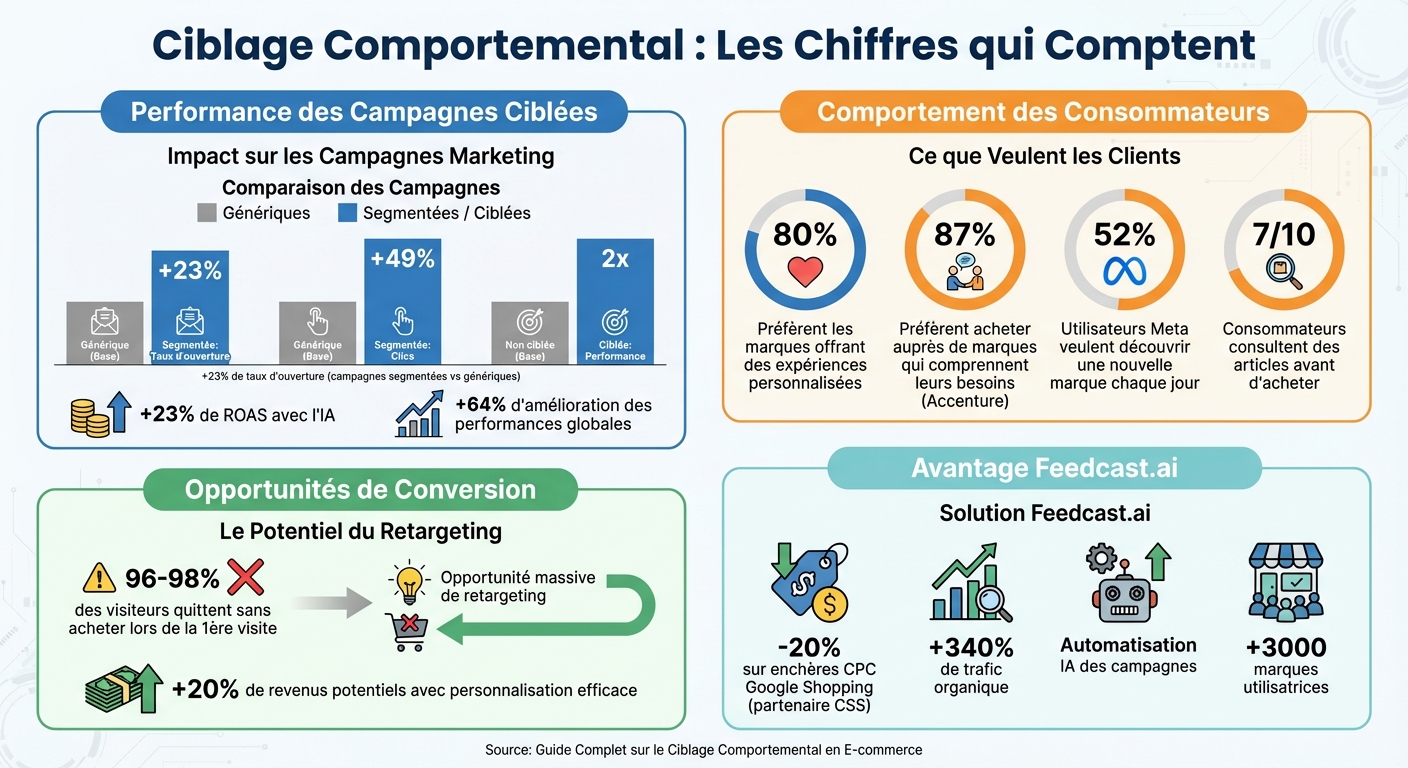 {Behavioral Targeting E-commerce: Statistics and Key Performance}
Types of behavioral data and customer segments
Types of behavioral data
E-commerce merchants collect a multitude of data to better understand and target their customers. Browsing patterns reveal how visitors interact with a site: which pages they view, which links they click, how long they stay, which paths they follow, and their scrolling behavior. Tools like heatmaps allow visualization of attention zones, and metrics like the bounce rate complement the analysis[7][8][9].
The purchase history is a mine of transactional information: it details ordered products, amounts spent, purchase frequency, transaction dates, as well as data like average basket size or number of items per order. Interactions with marketing campaigns are also tracked, whether clicks on emails, reactions to ads, or cart abandonments. Finally, technographic and geographic data reveal essential information about devices used (mobile or desktop), browsers, operating systems, and users’ locations[10].
Once analyzed, this data enables the creation of precise and actionable customer segments.
Customer segments for acquisition
Behavioral segmentation plays a key role in acquiring new customers. It allows grouping users based on their behaviors. For example, new visitors will need a different approach than regular customers or users active across multiple channels[10].
This segmentation significantly improves campaign performance. Targeted campaigns record on average 23 % more opens and 49 % more clicks compared to generic campaigns[1]. A concrete example: Intersport doubled its email open rate by segmenting its campaigns based on the sports practiced by its customers[11]. Meanwhile, Sephora uses a re-engagement strategy by sending personalized reminders just before customers run out of their cosmetic products, generating natural recurring purchases[11].
Once segments are defined, centralized data management allows optimizing every customer interaction.
Unified data management
Centralizing customer data is an essential step to offer real-time personalization and a consistent experience across all channels. A unified view brings together key information: website interactions, responses to advertising campaigns, purchase history, mobile app usage, and even customers' physical location[1][13]. This approach ensures continuity in the customer experience, regardless of the channel used[1][12].
The results are clear: 80 % of consumers prefer brands that offer personalized experiences[11]. This personalization can lead to a 20 % increase in revenue for companies that apply it effectively[11]. For example, Leroy Merlin implemented a customer data platform (CDP) that connects all its channels, enabling targeting—for instance—buyers of paint with ads for finishing products[11].
"Personalized and timely marketing requires knowing the people who make up your audience and understanding how they interact with your business." - Mailchimp[1]
Examples abound: Decathlon displays tailored recommendations on its homepage based on visitors' recent searches, while ASOS sends targeted emails to customers who abandoned their carts, including images of the forgotten products and similar suggestions[11].
Behavioral targeting throughout the customer journey
Attracting new customers
Behavioral targeting is not limited to already-known visitors. By analyzing online activities, such as engagement with content or signals indicating purchase intent, it enables you to identify and reach new prospects[3][2]. This method expands your audience by targeting people with interests similar to those of your current customers[3].
Artificial intelligence plays a key role in this phase. It detects users with high potential and generates similar audiences (lookalike) to reach a broader audience[3][14]. For example, an outdoor gear brand could target adventure enthusiasts, even if they haven't recently searched for hiking gear, by relying on their general habits and preferences[3].
Some figures illustrate this opportunity: 52% of users on Meta (Facebook and Instagram) say they want to discover a new brand every day[15], and 7 out of 10 consumers read informative articles before buying a product[4]. This allows you to design campaigns tailored to specific lifestyles, such as fashion enthusiasts or environmentally conscious consumers. You can also target life events, for example new parents or people who recently moved[3]. These strategies lay the groundwork for more effective retargeting.
Retargeting to drive conversions
Once a broadened audience has been reached, retargeting comes into play to turn those visits into concrete actions. This method is crucial, especially when 96 to 98% of visitors leave a site without making a purchase on their first visit[16][17].
The most effective retargeting scenarios include abandoned carts, visits to specific product pages, or repeated views of certain categories. These campaigns remind the user of the viewed products, often accompanied by attractive visuals and purchase incentives, such as limited-time promotions or low-stock alerts. A multichannel approach, combining personalized emails, display ads, and social media ads, maximizes the chances of conversion. Once conversion is achieved, the focus shifts to increasing customer lifetime value.
Growing customer lifetime value
Behavioral targeting plays an essential role in increasing customer lifetime value (CLTV). It encourages repeat purchases, improves conversion rates, and strengthens long-term relationships through hyper-personalized experiences[2].
Upselling and cross-selling rely on behavioral history: for example, offering premium products to customers with a “luxury” profile or suggesting a high-end audio system to those who bought a 4K TV[3][4]. Artificial intelligence also enables real-time recommendations of complementary products and reengages inactive customers with offers tailored to their past preferences[2][14][18]. Finally, loyalty programs reward regular purchases, thereby strengthening retention and long-term relationships with your customers.
Technology and implementation tools
Data collection and integration
Behavioral data collection relies primarily on web tracking technologies such as cookies and pixels, which record visitors' interactions on your site. These so-called first-party data are collected directly from your platforms, while automated scraping tools update product-related information[3][2][18].
To fully leverage these data, it is essential to centralize them via unified solutions. API connectors as well as integrations with systems like ERP and PIM make it possible to gather information from various sources[18][6]. Once consolidated, these data feed artificial intelligence algorithms that refine ad targeting with increased precision.
Targeting and optimization with artificial intelligence
Artificial intelligence is revolutionizing behavioral targeting by continuously optimizing bids, targeting and budget allocation to maximize advertising return on investment[5][14]. Thanks to this automation, campaigns can be adjusted in real time based on observed performance.
Furthermore, AI improves product data quality: it transforms low-quality visuals into professional-grade images and automatically generates variations[5]. Beyond visuals, AI-equipped platforms identify users with strong purchase intent and create similar audiences (lookalike audiences) that share characteristics with your best customers[5][14]. These technological advances form a solid foundation for solutions like Feedcast.ai.
How Feedcast.ai simplifies behavioral targeting

Feedcast.ai offers centralized management of your product feeds and simplified control of your multichannel advertising campaigns on Google, Meta and Microsoft, all from a single platform[5]. More than 3 000 brands trust Feedcast.ai to automate their campaigns.
The platform relies on artificial intelligence to enrich your product data and continuously optimize ad bids, enabling +23 % ROAS and +64 % improvement in performance compared to classic campaigns[5]. Its unified dashboard offers a clear view of your key metrics, such as ROAS, CPC and total spend[5].
As a Google-certified CSS partner, Feedcast.ai offers an automatic 20 % reduction on the CPC bids of Google Shopping, allowing you to increase your traffic without exceeding your budget[5]. Real-time product synchronization eliminates manual updates, while free distribution on platforms like Google Shopping boosts organic traffic by +340 %[5]. Plans start with a free offer with unlimited products, then move to paid subscriptions from 99 €/month depending on your needs[5].
These technological tools pave the way for precise performance analysis and regulatory compliance, aspects we will explore in the next section.
How to define your target audience in e-commerce? - Market answers you
Measuring performance and maintaining compliance
After covering targeting tools and methods, it is essential to focus on analyzing results and ensuring regulatory compliance.
Key performance indicators
To evaluate the effectiveness of your campaigns, track indicators such as click-through rate (CTR), conversion rate, ROAS (return on ad spend), CPC (cost per click) and, from a long-term perspective, customer lifetime value (CLTV)[2][5][19].
- The CTR measures the appeal of your ads by reflecting their ability to prompt users to click.
- The conversion rate, meanwhile, indicates the percentage of users who take action, such as making a purchase or signing up, and directly reflects your campaigns’ effectiveness[2][19].
- ROAS remains a key metric to calculate the revenue generated for each euro invested in advertising, giving you a clear view of the profitability of your efforts[5][19].
To go beyond immediate results, incorporate CLTV into your bidding strategies. This metric allows you to prioritize sustainable profitability by optimizing your campaigns for loyal customers rather than one-off sales[19]. Businesses that combine online and physical channels should also track metrics like store visits and in-store sales in order to measure the overall impact of their campaigns on the customer journey[19]. This data will help you adjust strategies in real time and maximize performance.
Data privacy and ethics
With the GDPR, personal data such as IP addresses, browsing history and online identifiers must be handled carefully and in strict compliance[20][21][22]. Within behavioral targeting, the use of explicit consent is often the most appropriate legal basis for collecting this information.
Favor first-party data to develop privacy-respecting advertising strategies that align with consumer expectations[4].
"The opportunity for us in the post-third-party cookie ecosystem is that we are the owners of our data. We are the only ones who know and understand our users, who have a repeated relationship based on the first-party cookie."
Stephanie Layser, Vice President of Advertising Technology at [News Corp][4]
To increase transparency, give users full control over their data by allowing them, for example, to easily manage their consent preferences. Clearly communicate the value they get from this data exchange[4].
Implementation roadmap
To ensure an effective and compliant transition, start with a comprehensive audit of your data to identify its origin and quality. Verify that your tracking infrastructure complies with GDPR guidelines, notably by implementing simple and accessible consent mechanisms. Deploy advanced conversion tracking by configuring precise tags on your site, and assign specific values to each transaction[19].
Before rolling out campaigns at scale, run targeted tests to adjust your strategies. Use value-based bidding to optimize ROAS while accounting for customer lifetime value[19]. Finally, introduce fairness controls and human oversight to ensure ethical and responsible targeting[14][3][4]. By regularly analyzing your results, adapt your approaches to maintain strong long-term performance[2].
Conclusion
Behavioral targeting transforms customer acquisition in e-commerce by enabling the identification and engagement of the most promising market segments through personalized messages tailored to each group’s specific expectations[1][23]. The numbers speak for themselves: targeted ads are twice as effective as non-targeted campaigns. Additionally, segmented campaigns record on average 23% higher open rates and 49% more clicks[1]. These results show how much this approach can improve your campaigns’ effectiveness while strengthening customer loyalty through tailored experiences.
By focusing on the most receptive audiences, behavioral targeting also helps optimize your resources and reduce customer acquisition costs[23]. By personalizing your messages based on each user’s behaviors and interests, your communications gain relevance, which naturally boosts conversion rates[1][24]. A study by Accenture even reveals that 87% of consumers prefer to buy from brands that understand their needs[1].
To facilitate the integration of these strategies, Feedcast.ai offers a platform that centralizes your ad campaigns and uses AI to enrich your data, optimize your bids and refine your targeting on platforms like Google, Meta and Microsoft. The result: an average ROAS increase of +23% and overall performance improvements of +64%[5]. All this while complying with GDPR regulations.
In summary, the combination of first-party data, precise segmentation and automation is key to converting your visitors into loyal customers. As explored in previous sections, behavioral targeting is no longer a luxury but an essential strategy to remain competitive in a constantly evolving e-commerce sector.
FAQs
How can behavioral targeting boost e-commerce sales?
Behavioral targeting is based on analyzing visitors' interactions on an e-commerce site. This includes elements like pages visited, time spent on the site, or products added to the cart. These data make it possible to better understand each user's preferences and purchase intentions.
With this information, brands can adjust their ads, product recommendations and promotions to more precisely meet customers' expectations. For example, retargeting a visitor who abandoned their cart or who viewed a product several times can be an effective strategy to encourage them to complete their purchase.
Tools like Feedcast use artificial intelligence to go even further. They enrich product data, generate tailored ads and optimize targeting in real time. Result: higher conversion rates and a better advertising return on investment.
How can compliance with the RGPD be ensured when using behavioral targeting in e-commerce?
To be compliant with the RGPD when using behavioral targeting, it is essential to rely on a solid legal basis. This can include the user's explicit consent, the performance of a contract or the pursuit of a legitimate interest. Consent, in particular, must meet four criteria: it must be free, informed, specific and verifiable. This means implementing clear forms that explain the purposes of the processing, the data collected and their use.
Transparency also plays a key role. Users must have access to a comprehensive privacy policy and be able to accept or reject cookies or other trackers via clear options. Limit data collection to what is strictly necessary and take measures to ensure their security, such as encryption and strict access controls. If profiling involves high risks, it is essential to carry out a data protection impact assessment (DPIA).
Finally, simplify the process for withdrawing consent and make it easy for users to exercise their rights, such as rectification or deletion of their data. Also ensure that your advertising partners adhere to the same data protection standards. By applying these best practices, you not only comply with the RGPD, but you also strengthen your users' trust.
How can artificial intelligence improve behavioral targeting in e-commerce?
Artificial intelligence (AI) is transforming how e-commerce merchants target their audiences by making advertising campaigns more precise and personalized. By analyzing user data, it identifies specific behaviors, such as cart abandonment or customer loyalty. This information makes it possible to create detailed audience segments, ensuring each user receives ads tailored to their needs and their purchase journey.
But that's not all. AI does more than personalize ads: it also generates ad content optimized for different channels, whether Google, Meta or Microsoft. This significantly reduces the time required to prepare campaigns while increasing their impact. At the same time, AI adjusts bids in real time based on predictions such as purchase probability or average order value. Result: e-commerce merchants can maximize their advertising ROI.
Through data analysis, automation and continuous optimization, AI enables e-commerce merchants to target the right audiences at the right time while controlling their ad spend. A game-changing advancement in the world of online commerce.
Yohann B.