How AI Predicts Ad Campaign Success
How AI centralizes and enriches data, trains predictive models, and adjusts budgets and creatives in real time to maximize ROAS.
AI is transforming advertising by enabling precise prediction of campaign performance. Through analysis of historical and real-time data, it optimizes budgets, improves targeting and continuously adjusts parameters. Here are the key points:
- Increased accuracy : Analysis of data to predict CTR, conversions and ROI.
- Automatic optimization : Real-time adjustments of budgets and bids.
- Data centralization : Platforms like Feedcast.ai consolidate Google, Meta and Microsoft Ads data to simplify management.
- Measurable results : Up to +30 % ROI and -12 % cost per acquisition thanks to tools like Performance Max from Google.
By combining data collection, feed enrichment, predictive models and dynamic adjustments, AI maximizes your advertising investments while simplifying their management.
::: @figure 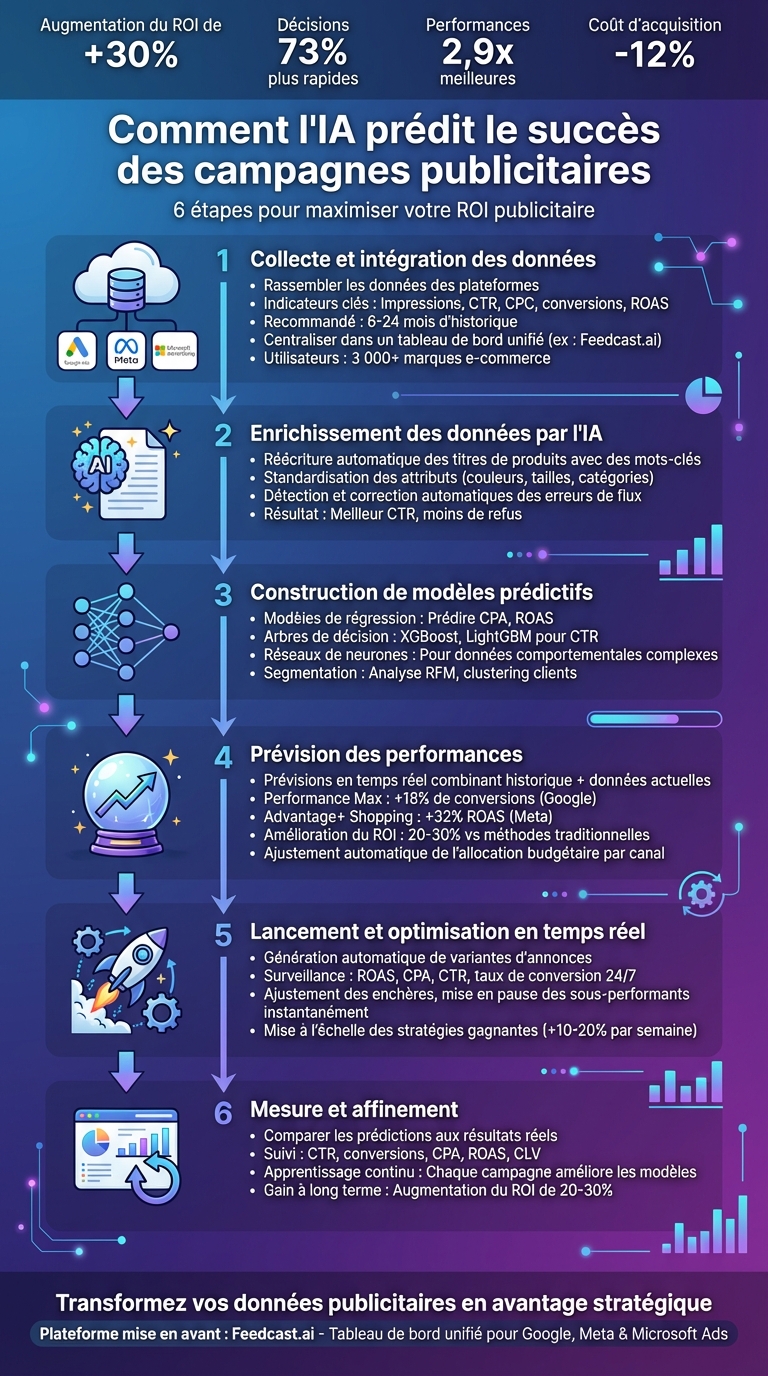 {6 Steps: How AI Predicts Ad Campaign Success}
Step 1 : Collect and integrate data from multiple advertising platforms
Gather historical and real-time campaign data
For AI to effectively predict your campaign outcomes, it is essential to start from a robust data foundation. Begin by collecting the main performance indicators (impressions, clicks, CTR, CPC, conversions, conversion rate, CPA, conversion value, ROAS, average cart value and revenue in euros (€)) from platforms like Google Ads, Meta Ads Manager and Microsoft Advertising. These metrics will allow you to compare performance across different platforms.
Also add audience data (age, gender, interests, remarketing segments, geographic location, device type and operating system) as well as creative information (ad type, visuals, main messages, calls to action and promotions in French). Don't forget to take into account the advertising context, such as keywords, bidding strategies (manual CPC, tCPA, tROAS), daily budgets and run times, using the local 24-hour format (for example, 13:00).
To obtain reliable forecasts, it is recommended to have 6 to 24 months of historical data per account, with a sufficient volume of clicks (several thousand) and conversions (tens or hundreds) for each campaign type. In sectors marked by seasonal variations, such as fashion or high-tech, two years of data allow capturing key periods (sales, back-to-school, Black Friday, end-of-year holidays). This data enables AI models to detect seasonal trends and refine forecasts on metrics like CPC, conversion rate or ROAS.
Once all this data has been collected, centralize it for an overview and cross-analysis.
Centralize data in a single platform
To avoid data fragmentation and simplify management, gather it in a single dashboard. A centralized platform provides an overall view of spend, clicks, conversions and ROAS, broken down by channel, campaign or product - all expressed in euros (€). This makes cross-platform comparison simpler: you can quickly identify the channel offering the best CPA or ROAS for a specific audience, creative or product category in France, and adjust your budgets accordingly.
A good example of this approach is Feedcast.ai. This platform connects your Google, Meta and Microsoft ad accounts via OAuth in a few clicks, then automatically synchronizes historical and real-time data (typically every hour or daily). It standardizes the varied structures of the platforms (for example, campaign, ad group, keyword on Google, or campaign, ad set, ad on Meta) into a single format. This allows the AI to compare and aggregate performance consistently. Already adopted by more than 3 000 e-commerce brands, this solution helps save time and maximize ROI through precise, fast omnichannel analysis.
Step 2: Enrich data with AI-powered tools
Improve product data quality
Once your data is centralized, it is essential to ensure the quality of your catalog to obtain reliable forecasts. Accurate data allow AI models to focus on the elements that truly influence performance, such as brand, category, price range or promotions, rather than on random information. When product titles, descriptions and attributes are clear and well-structured, algorithms can easily associate specific characteristics (for example, “women’s running trainers”, “genuine leather”, “free shipping”) with outcomes like a higher click-through rate (CTR), a higher conversion rate or a return on ad spend (ROAS). In fact, Google emphasizes that well-structured product data is the key factor for success in Shopping ads.
Thanks to AI, it is possible to automatically rewrite titles to include relevant keywords and key attributes in natural French. It also enriches descriptions by highlighting use cases and specific benefits (“perfect for daily running”, “delivery in 48 h in mainland France”). In addition, it standardizes attributes (like “navy blue” instead of “navy”), adjusts sizes to European formats, uses metric dimensions (cm, kg) and assigns the appropriate categories for Google, Meta or Microsoft based on text and historical data. This meticulous organization improves relevance between your products and user searches, which increases impressions, CTR and conversions — signals that are essential for refining forecasts.
A concrete example of this approach is Feedcast.ai. This platform imports your catalog from tools like Shopify, WooCommerce or PrestaShop, then uses AI to enrich titles and descriptions in French, add missing attributes (such as size, color or gender) and standardize metric and pricing formats (for example, 49,90 €). You can also apply global rules, such as automatically adding “Livraison gratuite dès 50 € d'achat” to eligible products or prefixing titles with the brand name. All changes are managed from a single interface, ensuring perfect consistency across Google, Meta and Microsoft Ads, which strengthens the reliability of your predictive models.
This improvement phase also prepares the ground to identify and fix feed errors.
Detect and correct feed errors
Once product data quality is improved, it is crucial to correct feed errors that could hinder your performance. Common issues include missing required fields (title, description, image, price, GTIN), inconsistent attributes, outdated prices or miscategorized products. These errors can negatively impact your campaigns. AI can automatically analyze your feed to spot anomalies, such as zero stock for best-sellers, prices that are far from the category average, or titles in English for a French campaign. It also identifies formatting errors (like a wrong decimal separator or an incorrect currency) and detects inappropriate categories by analyzing text and images.
But AI doesn’t just flag problems: it also proposes concrete solutions. For example, it can generate a compliant title variant, infer a missing color from an image, standardize a size from free-text or assign the correct Google category. These corrections can be applied automatically via defined rules (like harmonizing decimal separators or color names) or batch-validated. This continuous process allows you to clean new products and catalog updates in near real time. The result: fewer disapprovals, downtimes and campaign resets, ensuring stable performance and forecasts based on reliable data.
By combining data enrichment and error correction, you establish a smooth, ongoing process that is essential for robust advertising forecasts and high-performing predictive models.
Step 3: Build and train predictive models
Apply machine learning to advertising
Once your data is centralized and enriched, the next step is to develop models capable of predicting the performance of your advertising campaigns. Regression models such as linear regression, ridge or lasso are particularly useful for estimating metrics like CPA (cost per acquisition) or ROAS (return on ad spend) in euros, while remaining easy to interpret. For more complex relationships, decision trees and ensemble methods (like random forests or gradient boosting algorithms such as XGBoost and LightGBM) prove effective. These tools can account for non-linear effects and complex interactions, predicting metrics like CTR or conversions while incorporating factors such as device, time of day or seasonal variations. Finally, neural networks come into play when processing massive volumes of behavioral data, offering even more precise engagement forecasts.
In the French context, e-merchants often favor gradient boosting models to predict metrics like CPA. Neural networks, meanwhile, are generally adopted only when the complexity or volume of data justifies them. Once models are in place, a centralized platform can automatically adjust budgets and bids based on the predictions generated.
The next step is to use these models to segment your audiences and analyze their behaviors in detail.
Segment customers and analyze behaviors
To group your audiences by behavior, techniques like clustering (for example, k-means or Gaussian mixtures) and enhanced RFM segmentation are valuable tools. These methods allow analysis of criteria such as purchase frequency, average basket (in euros), recency of interactions or product categories viewed. These analyses lead to the creation of segments such as “high-value new buyers”, “loyal customers” or “promotion seekers”.
These segments can then be used to create custom audiences on platforms like Google and Meta. For example, high-value customers can receive remarketing ads featuring high-margin products, while less purchase-prone segments can be offered educational messages or more incentivizing offers. In addition, predictive models estimate the probabilities of transition between different stages of the conversion funnel (impression, click, visit, add-to-cart, purchase). These propensity scores enable more precise targeting and greater campaign personalization. By centralizing this data, it becomes possible to automatically adjust advertising strategies to maximize their effectiveness.
Step 4: Forecast campaign performance and key metrics
Predict campaign outcomes using real-time data
With the predictive models developed earlier, AI shifts into high gear: it anticipates performance in real time and adjusts ad spend accordingly. Once models are trained, AI combines historical data (such as past channel performance, audience behavior, creative assets, seasonality, or device type) with current data streams (impressions, online browsing, competing bids, economic trends). For example, if a drop in engagement is detected on a social platform, forecasts are immediately adjusted and the budget is reallocated.
Thanks to this continuous update of forecasts, e-merchants in France can react without delay. Companies that incorporate predictive analytics into their marketing strategy see ROI improvements ranging from 20 to 30 % compared to traditional approaches[2][7]. Furthermore, Google’s Performance Max campaigns generate on average 18 % more conversions for a similar cost per action[2]. Meanwhile, Meta’s Advantage+ Shopping campaigns report a 32 % higher ROAS thanks to predictive optimization[2]. These results show how AI turns rigid forecasts into dynamic adjustments, thereby maximizing revenue in euros.
Feedcast plays a key role by centralizing data from major channels, enabling AI to refine its forecasts by product and by platform[1]. This granularity helps identify the most profitable items and the most suitable platforms, while taking into account key periods for French consumers, such as the winter sales, Black Friday or the back-to-school season. In short, this dynamic forecasting does more than predict outcomes: it also paves the way for reactive and efficient budget management.
Optimize budget allocation based on forecasts
AI does more than predict — it acts. Based on key metrics, it automatically reallocates budgets in real time to optimize every euro invested. For example, if models indicate that Google Shopping can generate a ROAS twice as high as display campaigns, AI will redirect part of the budget to that channel[3][4].
This reallocation is continuous: hour by hour, the algorithm adjusts spend toward the best-performing ads, keywords or audience segments[3][4]. For French e-merchants, this means defining precise limits in euros, such as a minimum ROAS, a maximum CPA or daily budget caps per platform. These safeguards allow businesses to maintain control while benefiting from the flexibility offered by automation. Result: companies that use predictive analytics make decisions 73 % faster and achieve campaign performance 2,9 times higher[2].
sbb-itb-0bd1697
Step 5: Launch, monitor and optimize campaigns in real-time
Automate ad creation and targeting
Once predictive models are in place, AI simplifies campaign launches by automatically generating ads adapted to French standards, such as prices including VAT (TTC) and GDPR rules, for platforms like Google Shopping, Meta or Microsoft Ads. Take the example of a fashion e-merchant: AI can create multiple ad variants, such as « Free shipping from 50,00 € » for Google Search, an Instagram carousel highlighting a promo « -20 % this weekend », or dynamic ads to target abandoned carts[4]. This automation allows testing a much larger number of creatives without blowing up costs, while letting marketers validate compliance before deployment.
At the same time, AI relies on behavioral data (pages visited, adds to cart, past purchases), contextual data (device type, time, location) and demographic data to build relevant audiences. This includes strategies like prospecting using lookalikes of top customers or dynamic retargeting for visitors who did not convert. Centralizing data ensures audience consistency across all ad platforms. Result: more targeted ads, personalized messages, and ultimately better conversion at lower cost.
Real-time data-driven adjustments
Once campaigns are launched, AI continuously monitors key metrics such as spend (in euros), ROAS (return on ad spend), CPA (cost per acquisition), revenue, conversion rate, CTR (click-through rate) and average order value. These data are analyzed by channel, device, region and creative type[3]. If a campaign underperforms, for example with a CPA that is too high, AI automatically adjusts bids or pauses underperforming ads. Conversely, if a specific combination, such as a mobile search in Île-de-France between 18 h and 22 h, shows a ROAS above 800 %, AI recommends increasing bids or reallocating budget to that profitable segment.
Optimization runs 24 h/24, 7 j/7. AI adjusts not only bids and creatives, but also refines audiences by excluding low-engagement segments or expanding high-performing lookalikes. Marketers retain control thanks to safeguards defined upfront, ensuring that business objectives and logistical constraints (such as inventory or delivery capacity) are respected. Once adjustments are made, the best-performing strategies can be identified and scaled.
Develop winning strategies
When certain campaigns show consistent results, such as stable ROAS and CPA over several days or weeks, AI analyzes them to determine growth potential. It checks that conversion volume is statistically reliable and assesses upside margins, such as impression share lost due to budget[3][5][6]. Before increasing budgets, AI ensures ROAS stays above the target and that resources (stocks, logistics, margins) can absorb an increase in demand. For example, if a Meta retargeting campaign shows a CPA of 15,00 € and a stable ROAS of 650 %, AI proposes gradually increasing the budget by +10 % to +20 % per week, while closely monitoring profitability[2][3].
The top-performing combinations - such as a specific audience, a creative and an offer - can then be adapted to other formats or platforms. For example, a successful Google Search campaign can be ported to Performance Max, or a high-performing Facebook feed piece can be tested on Instagram Stories. AI automatically adjusts placements and bids for each new format[3]. With fine segmentation, it identifies the most profitable products and audiences, then orchestrates scaling across multiple channels from a centralized dashboard, avoiding tedious manual adjustments in each ad account[1].
In summary, AI does more than predict success: it acts continuously to maximize every euro invested, adapting campaigns hour by hour to get the best return.
How marketers can use predictive AI to prove ROI #Shorts #Advertising #Marketing
Step 6: Measure ROI and refine future campaigns
Analyzing results once the campaign is over is crucial to adjust your upcoming strategies. Measuring ROI accurately provides valuable insights and enables continuous performance improvement.
Evaluate the gap between forecasts and results
After a campaign ends, it is essential to compare the results obtained with the AI's initial forecasts. This helps spot discrepancies and assess the reliability of the models used. Track key metrics such as CTR (click-through rate), conversions, CPA (cost per acquisition), ROAS (return on ad spend) and CLV (customer lifetime value).
For example: if the AI had predicted a CTR of 5% but the final result is 3%, this may indicate an issue with targeting or ad creatives[6]. Conversely, an actual ROAS of 4.2×, 12% higher than forecasts, shows that your strategy exceeded expectations[1].
Unified dashboards, which centralize this data in real time, simplify analysis and allow you to quickly identify segments needing adjustments. These observations then become the basis for refining your models and improving future campaigns.
Improve models through continuous learning
Modern AI systems do not remain static: they learn and improve by incorporating data from past campaigns using machine learning algorithms[6]. Each gap between forecasts and results feeds these models, enabling them to sharpen their predictions for the next campaigns. Companies that adopt this iterative approach often see ROI increases of 20 to 30% over the long term, as their models become more effective with accumulating data[2][4].
For example, AI can detect changes in consumer behavior, such as a longer decision cycle during periods of economic uncertainty, and adapt its forecasts accordingly. Modern platforms automate these adjustments: after each campaign, new data is integrated automatically, and alerts are generated if significant deviations (greater than 10–15%) are detected[5].
A monthly audit of the models also ensures that forecasts remain reliable and relevant. This process turns every euro spent into a learning opportunity, allowing you to optimize your ad budgets with greater precision and maximize long-term return on investment.
Conclusion
Artificial intelligence is profoundly transforming e-commerce advertising, shifting from a reactive approach to a predictive strategy. By combining data collection, AI analysis, predictive modeling, forecasting, real-time optimization and ROI evaluation, you can reinvent the way you design your ad campaigns. These six steps form an integrated process to maximize the effectiveness of your advertising efforts — an essential lever for success in the world of e-commerce.
The numbers speak for themselves: companies that rely on predictive analytics make decisions 73% faster and achieve 2.9× better performance[2]. At the same time, they see long-term ROI increases ranging from 20 to 30%[2][4]. Solutions like Feedcast.ai make these results accessible. This tool centralizes multi-channel management (Google, Meta, Microsoft Ads), automatically enriches product feeds using AI and continuously optimizes campaigns to maximize ROAS. With a unified dashboard and real-time analytics, it simplifies ad management while delivering measurable performance.
Continuous learning is the key to lasting success. Each campaign feeds the predictive models, making their forecasts ever more accurate and strengthening your competitiveness at every step. By adopting Feedcast.ai, you turn your data into a true strategic asset while boosting the growth of your online store.
FAQs
How can artificial intelligence predict the success of ad campaigns?
Artificial intelligence plays a key role in predicting the success of ad campaigns by decoding complex data to spot trends and opportunities. Using sophisticated algorithms, it helps refine audience targeting, enrich product information and adjust strategies in real time.
These capabilities give companies the ability to increase product visibility, reduce wasted spend and optimize their return on investment (ROI).
What information does AI use to predict the success of ad campaigns?
To anticipate campaign outcomes, artificial intelligence relies on several types of key data: campaign history (such as impressions, clicks, conversions and costs), product details (titles, descriptions, features), target audience specifics, as well as the budgets set.
With this information, predictive models can detect trends and adjust campaigns to make the most of them.
How does AI automatically optimize ad budgets?
Artificial intelligence transforms ad budget management by enabling real-time analysis of campaign performance. It identifies the most responsive audiences and reallocates resources to the segments that generate the best results, thereby optimizing return on investment.
By adopting this data-driven approach, companies can adjust their ad spend with greater precision. This not only helps reduce wasted expenditures but also maximizes the impact of their ad campaigns.
Geoffrey G.